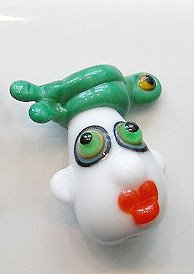
There are different types of glass used in beadmaking. Each glass has a different melting temperature. The most commonly used is soft/soda glass bought under the name of Moretti. Other brands are available too, but Moretti is the one with the most colours and most common.
Hard/Pyrex/Borocilicate glass has a higher melting temperature and requires special eye protection for artists who work with it. The rewards are many including the colours that are visible within the glass.
The difference between the two types has led many users of Moretti to try and emulate the look of borocilicate glass. To acheive the beauty without the extra equipment and knowledge.
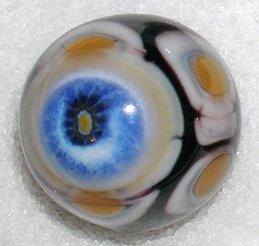
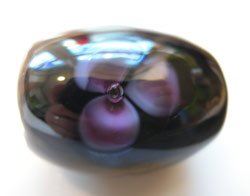
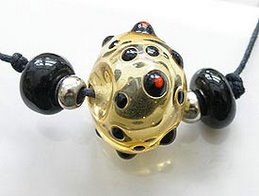
This is what I was attempting with the beads below. When Iris Gold is combined with Straw Yellow, very pretty things happen! These beads are the result, I layed a twisty over different colours of transparent Moretti and then encased the beads to give the full effect.
I had several crack on me sadly, I was trying to figure out why, and it turns out that the Iris Gold is a different type of Glass to Moretti. It has a different COE (Co-efficient Of Expansion), and this is what the problem is -- too bad because they are quite beautiful when the light shines through them. There's an unwritten law that says don't add more than 5% of a different COE to your bead, so perhaps if the twisty was used very sparingly the beads wouldn't be so prone to cracking. Who'd-a-thunk making pretty things required all this Science????

Med blue transparent (I think) base

Dark amber base
 Red transparent base
 Uranium Yellow base

So, I'm not sure if I'll pursue these beads - the iris gold is quite expensive - too expensive to go into the cracked bead pot anyway! I did learn good things though and I'm starting to understand how to encase a bead. Previous attempts have been pretty futile, but I'm starting to get a feel for how the hot glass goes onto the bead to give a nice clear layer without disturbing the decorated layer below.